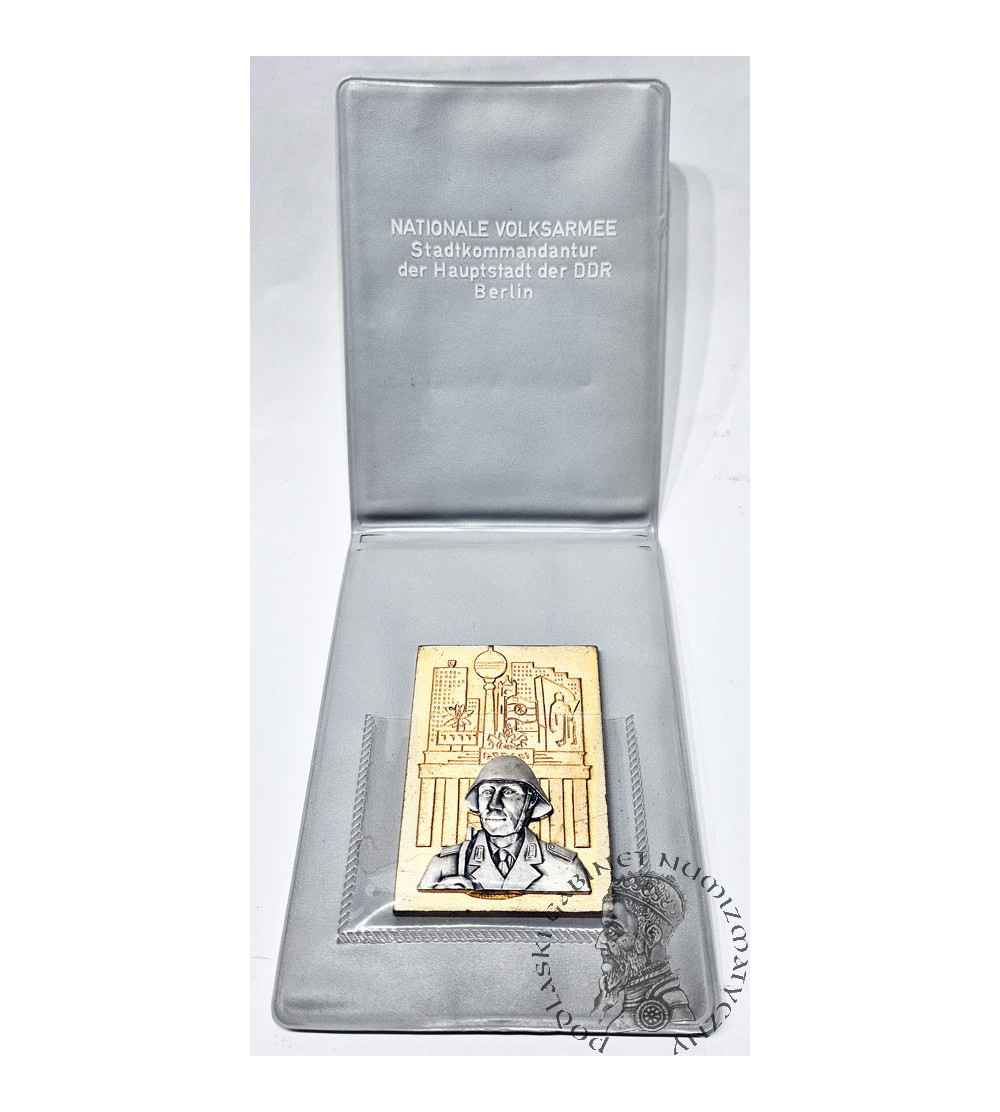
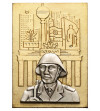
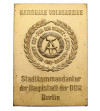
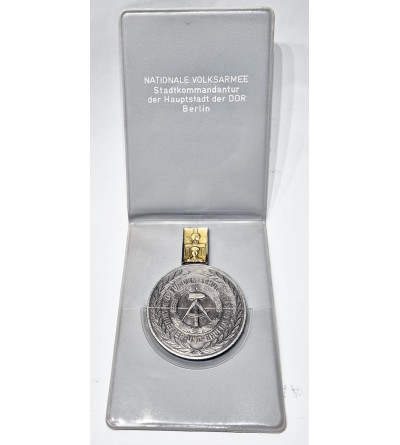
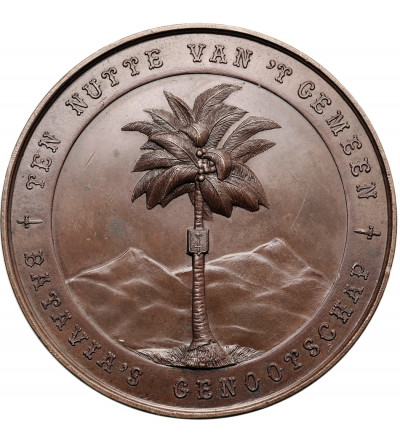
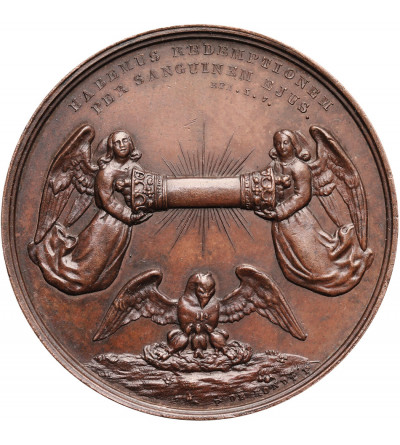
Germany, German Democratic Republic (GDR/DDR). Medal/plaquette of the National People's Army, Municipal Command of the GDR Capital Berlin, white gilded metal, 70 x 50 mm, weight 107,70 g, Condition aUNC, original case (signs of wear)
(There are 16 other products in the same category)
Germany, Democratic Republic (NRD/DDR). Olympic medal 1974 Werner Seelenbinder, Cu-Ni 40 mm, weight 24,70 g., Condition aUNC
Belgium, Antwerp, Leopold II (1865-1909). Satirical medal 1868, Jozef Cornelis Van Put (1811-1877), Copper 30 mm, weight 8,8 g, Condition aUNC
France, Calvados. Souvenir medal 1893, souvenir of an equestrian event, Legoux-Longpré (Member of Parliament for Calvados in 1893/1894), white metal 32 mm, weight 14,70 g., on the edge signed MAILLECHORT, Condition XF, edge nicks
Belgium. Medal 1830 commemorating the glorious defenders of Belgium, GLOIRE IMMORTELLE AUX BRAVES DEFENSEURS DE LA BELGIQUE (IMMORTAL GLORY TO THE Valiant DEFENDERS OF BELGIUM), A NOS FRERES QUI ONT SUCCOMBE (TO OUR BROTHERS WHO SUSPENDED), Bronze 37 mm, weight 28,70 g., Condition aUNC, nice patina with luster
France, Burgundy. Commemorative medal of the Agricultural Society of the Canton of Seurre, circa 1910, Societe Agricole Syndicale du Canton de Seurre Côte-d'Or, signed L. Patriarche, gilt bronze 40 mm, weight 30,50 g., Condition aUNC
Belgium, Leopold I (1831-1865). Medal commemorating the Royal Decree of February 7, 1844, , “L'UNION FAIT LA FORCE”, by Veyrath, Bronze 32 mm, weight 16,80 g., Condition XF
Belgium, Baudouin of Belgium (1951-1993). Medal 1951, Federation of National Veterans of King Albert (1909-1934), National Pilgrimage to the Royal Crypt on February 17, 1951 organized by the Brussels Section, Bronze 50 mm, weight 56,90 g., Condition aUNC, original FISCH box, 59 Rue Edm. Rostand, Bruxelles
Great Britain, George II (1727–1760). 1736 Medal, AMERICAN COLONIES Jernegan Lottery, by John Sigismund Tanner, obverse: Minerva standing among trophies and emblems, reverse: Queen Caroline watering a grove of young palm trees, MI 517/72, Betts 169, Ford XIII 841, Silver 39 mm, weight 19,6 g, Condition Fine
Belgium, Leopold I (1831-1865). Bronze medal 1852, dedicated to Pierre Theodor Verhaegen, President of the House of Representatives, Belgian politician, founder of the Free University of Brussels, by L. Wiener, Bronze 67,00 mm, weight 124,37 g., Condition aUNC, nice brown patina with luster.
Canada, George VI (1936-1952). Sudbury commemorative medal, 1751-1951 5 cents, 200th anniversary of insulation and "Nickel" element designation, Sudbury “Numismatic Park”, Aluminum 38,0 mm, weight 6,1 g., Condition UNC
Belgium, Leopold I (1831-1865). Medal 1839 from the Annual Horse Races, by Braemnt F., Bronze 47 mm, weight 39,20 g., Condition aUNC, beautiful brown patina with luster
Germany, Saxony - Anhalt, Naumburg Bishopric. Satirical Silver Medal, no date, on the dispute over the bishop of Naumburg, Julius von Pflug (1499-1564), dated 1543, Fieweger collection 163, Whiting collection 48, cast Silver 37 mm, weight 20,30 g., Condition VF, patina
Obverse: Pope's head wearing a papal tiara, but when inverted showing a horned devil, legend all around: ECCLESIA-PERVERSA-TENET-FACIEM-DIABOLI (translation: “The perverted Church received the face of the devil”).
Reverse: Head of a cardinal wearing a cardinal's hat, but when inverted showing a jester wearing a fool's hat, legend all around: SAPIENTES- - STVLTI-ALIQVANDO- (translation: "The wise are sometimes fools").
Sweden, Medal by Lea Ahlborn commemorating the death of Queen Lovisa in Stockholm on March 30, 1871, pewter/tin 42 mm, weight 33.42 g., condition XF+, nice luster.
Louise was born in August 1828 in the Hague, and was the daughter of Fredrik of the Netherlands and Louise of Prussia.
She was chosen as a suitable wife for the Swedish heir to the throne, Karl (XV). Their wedding took place in June 1850 and her official name became Lovisa. In 1859, she became queen of Sweden and Norway. Lovisa and Karl XV were very different, and their relationship was never particularly happy. They had two children, of whom only their daughter reached adulthood.
Lovisa devoted herself to charity work and was the patron and founder of several associations, such as a care home for sick children, a school for deaf children, and a society for the establishment of orphanages in Lapland.
Hungary / Austria-Hungary, Franz Joseph I (1867-1918). Coronation medal in Buda 1867, “Eljen a haza es az alkotmany” (Long live the homeland and the constitution!), Bronze 38 mm, weight 18,9 g, Condition VF, minor corrosion
Australia. Commemorative medal 2012, XXX Olympic Games, London 2012 - aquatics-swimming, Bronze 40 mm, weight 27 g., condition Prooflike
France, Napoléon III (1852-1870). Medal 1856 commemorating the baptism of Prince Imperial Eugene Louis Jean Joseph, Brass 23 mm, weight 5,0 g., Condition aXF
Napoléon Eugène Louis Jean Joseph Bonaparte, Imperial Prince, known as Louis-Napoléon, born March 16, 1856 in Paris and died June 1, 1879 in Zulu country (South Africa), was the only son of Napoleon III, Emperor of the French, and his wife, Empress Eugenie. He is sometimes referred to as “Napoleon IV.”
Germany, German Democratic Republic (GDR/DDR). Medal/plaquette of the National People's Army, Municipal Command of the GDR Capital Berlin, white gilded metal, 70 x 50 mm, weight 107,70 g, Condition aUNC, original case (signs of wear)