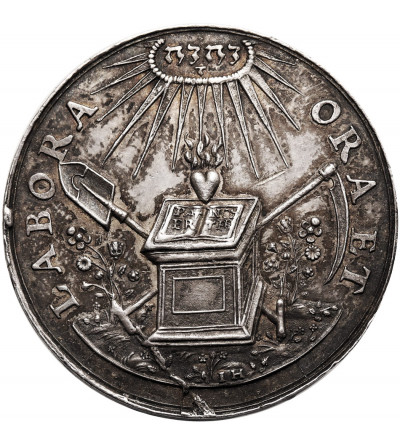
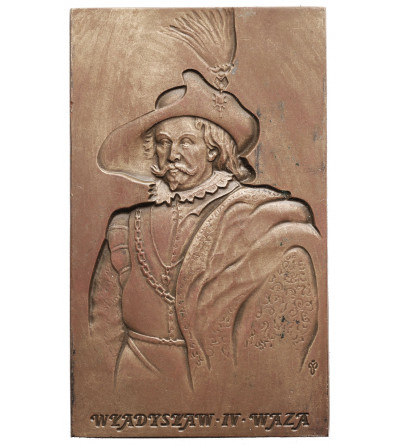
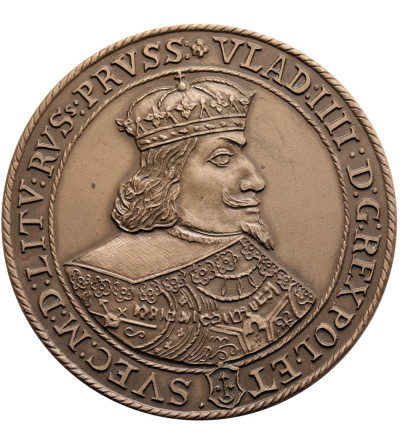
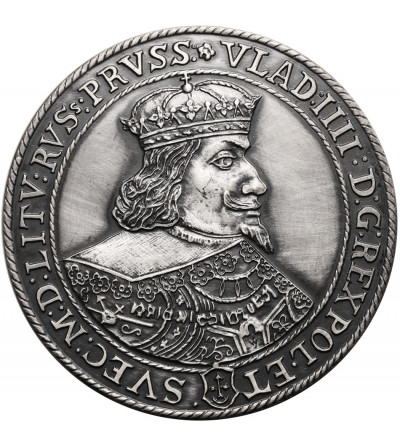
Władysław IV Waza 1632-1648

Active filters

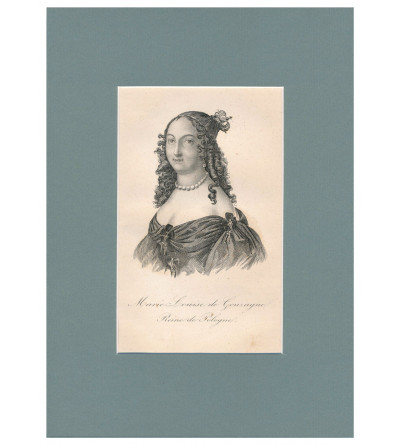
Ludwika Maria Gonzaga, Queen of Poland, portrait, steel engraving...

Ludwika Maria Gonzaga, Maria Ludwika Gonzaga (1611-1667) Queen of Poland, wife of Wladyslaw IV Vasa and later of Jan Kazimierz Vasa. The only female ruler in the country`s history to marry two rulers in succession, and to top it off: two brothers. She was a well-born French aristocrat, ruling Nevers, located in Burgundy, and other estates of the Gonzaga family since 1637. The proposal of her marriage to the Polish king, Ladislaus IV, came from the influential Cardinal Mazzarini, playing a key role at the Parisian court. The wedding took place in 1646.At the side of her husband Louis, Maria played a limited role, but when he died prematurely, she quickly married his brother and successor. She was very active both before and during the Swedish Deluge; it was she who led to the famous Lvov Vows, in which the kingdom was placed under the protection of the Virgin Mary. She also forged an alliance with the Habsburgs against Sweden in 1656. She created a strong pro-French party at the Polish court. She also tried, albeit unsuccessfully, to push through the candidacy of a Frenchman, Henry d`Enghien, to succeed Jan Kazimierz. She died in 1667, which largely pushed the widowed king to relinquish the crown. Source: ciekawostkihistoryczne.pl CHODŹKO, Leonard Borejko (1800-1871), La Pologne historique, litteraire et monumentale, (...), 1835-1842. A monumental work by the famous Polish émigré publisher Leonard Chodźko which is a history and geographic-political description of Poland. The work was published in three volumes. The first part is the history of Poland from the earliest times to the reign of Wladyslaw Lokietek. The second volume covers the history of Poland from the reign of Casimir the Great to the death of Stefan Batory, while the last volume covers the history of Poland from the beginning of the reign of Sigismund III Vasa until the events contemporary to the Author and the Readers, i.e. the November Uprising. Each part also contains descriptions of unique and interesting places in Poland, as well as basic information about literature, art and science. In addition, the work contains examples of exceptional monuments in the Polish lands. An important part of the work includes fairy tales, legends and short stories, as well as an essay on dramatic theater in Poland. The work also contains a description of Polish dances, such as the polonaise, mazurka, and krakowiak. The work is very richly illustrated, with numerous intaglios, natural monuments, sacred objects, castles, palaces, cities, portraits of important historical figures from the history of Poland, works of art, notes of songs, etc. This brings the total to 180 engravings (including maps), in a set of three volumes, i.e. 60 engravings for each volume collated with a table at the beginning of the volume.
KOD: 4611105R
PLN450.00

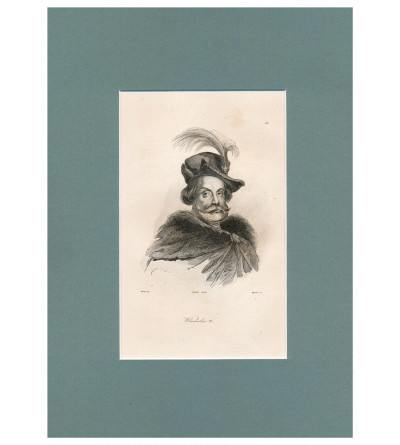
Ladislaus IV Vasa, King of Poland, portrait, steel engraving 19th...

Ladislaus IV Vasa (1595-1648) - electoral king of Poland from 1632-1648, of the Vasa dynasty. He was the eldest son of Sigismund III Vasa and Anna of Austria. He was born on June 9, 1595 in Łobzów near Kraków. Already in his youth he was used in political games. After the Polish army occupied Moscow in 1610, the boyars appointed him tsar on the condition that he change his religion to Orthodoxy. In the face of his father`s resistance, this condition was rejected, and the project to install a Polish royal on the Moscow throne collapsed. Two expeditions organized to obtain the Moscow crown - in 1612 and 1617-1618 - ended in failure. In 1621, Wladislaw led a Polish army to Chocim, although knocked down by illness he did not take part in the fighting. He enjoyed great popularity among his subjects. In 1632, after the death of his father, he was elected as the new king in the course of one of the most peaceful and consensual elections in the country`s history. The first challenge that awaited the new monarch was the war with Moscow. The Russians attacked Smolensk in 1632, but the relief organized by Wladislaw forced them to capitulate. In May 1634, the Republic signed a favorable peace in Polanov, but the king had to relinquish his claim to the tsarist crown. While the Smolensk War was still in progress, the Poles also repulsed a Turkish-Tartar invasion. In turn, in 1635, the king, forced by the Polish mighty (he himself pushed for war, hoping to regain the Swedish throne), concluded a 26-year truce with Sweden in Sztumska Ves. Relations with the Cossacks were less favorable during Wladislaw`s reign. In 1635-1638 there were several uprisings, brutally suppressed by Crown and magnate troops. After ten years of relative peace, in 1648, the Khmelnytsky uprising broke out. The king did not live to see its end - he died on May 20, 1648, a few days after the defeat of the Republic at Yellow Waters. He was the founder of the Polish navy and a committed patron of the arts. In 1637 he married the Austrian Archduchess Cecilia Renata Habsburg, and after her death, the French aristocrat Louise Marie Gonzaga. With his first wife he had a son and a daughter, who, however, did not live to adulthood. It was he who, in honor of his father, erected Sigismund`s column on the castle square in Warsaw. Source: ciekawostkihistoryczne.pl
KOD: 4611173R
PLN400.00