Polski
 English



- New
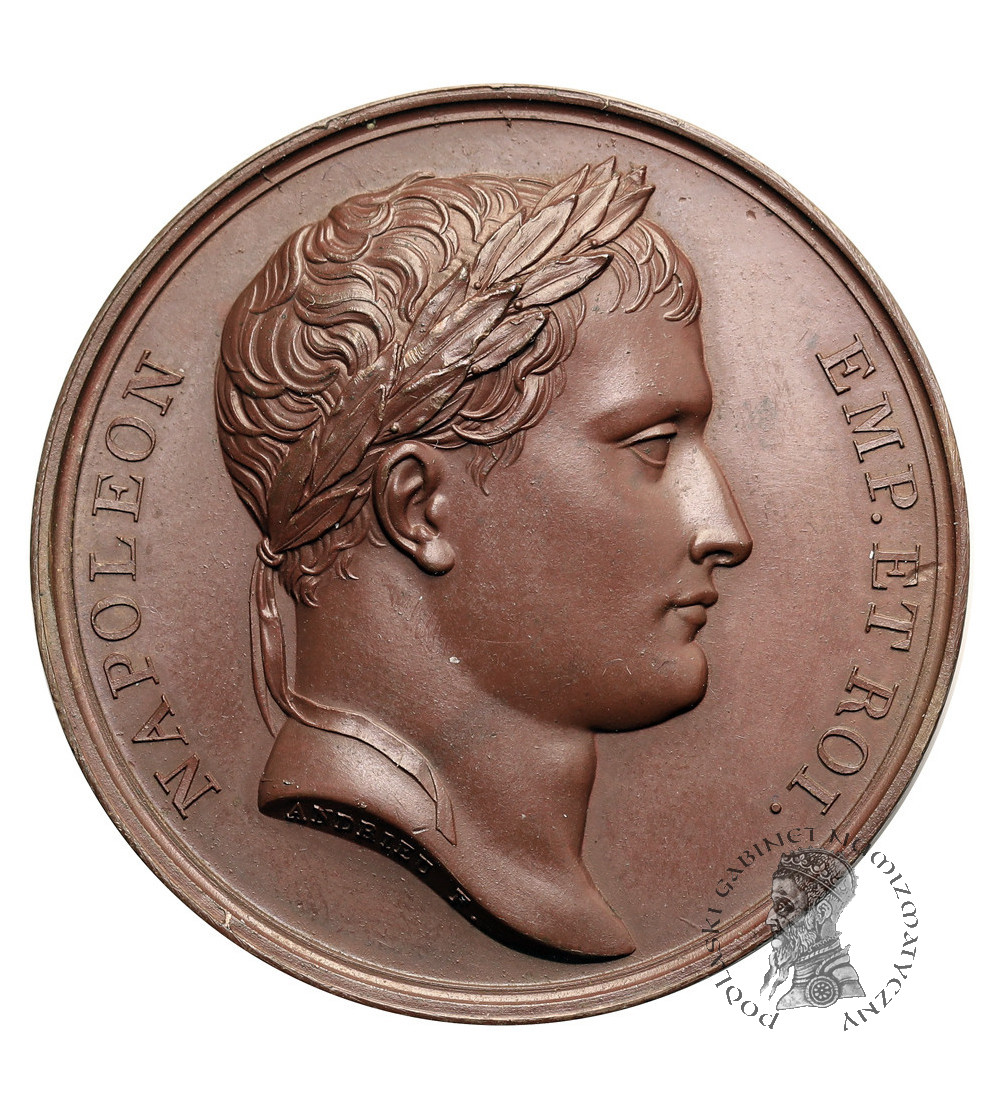


Russia / France, Napoleon I (1804–1814, 1815). Medal 1812 commemorating the French Army on the Dnieper, by Andrieu and Brandt, Bramsen 1158, Bronze 40 mm, weight 37,80 g., Condition aUNC, beautiful brown patina with a glossy finish
Russia / France, Napoleon I (1804–1814, 1815). Medal 1812 commemorating the French Army on the Dnieper, by Andrieu and Brandt, Bramsen 1158, Bronze 40 mm, weight 37,80 g., Condition aUNC, beautiful brown patina with a glossy finish
Rivers and the Destruction of Napoleon’s Grand Army
By: Anthony Kuhn
Indeed, river crossings took on the appearance of a desperate escape rather than well-planned strategic maneuvers. At Krasnoe, Kutuzov believed the French rear guard under Marshal Ney to be trapped at the Dnieper River and sent an officer to negotiate a surrender of the French force (Lejeune 366-7). Ney used this time to assess the feasibility of crossing the Dnieper since it was frozen, and the rear guard escaped over the ice, at the cost of leaving behind “the artillery, baggage, and even the wounded” (Lejeune 367). Marshal Ney should be commended for the crossing as it saved the rear guard from being taken prisoner or obliterated, but it is clear Kutuzov had outmaneuvered the French and it was only the chance happening that the Dnieper had frozen over near Krasnoe that allowed them to escape. This is because at Orcha later that month, the Dnieper had not frozen and the French were compelled to construct two pontoons under heavy bombardment from the Russians. The wounded were again left behind as the French set fire to the pontoons in order to achieve momentary relief from the Russian pursuit. It would be a perpetual action during the retreat; the French army abandoning wounded and noncombatants at rivers in order to escape the fierce maneuvers of the Russians.
All was over for the Grand Army for all practical purposes at the end of November 1812. The French did not suffer another major engagement until they reached the haven of Poland , yet by then only 50,000 of the original force of 600,000 remained. Rivers had played a major part in the demise of the Grand Army. It could be said the lack of rivers running on an east-west axis doomed an invasion of this magnitude from the start because a supply train of land wagons was not adequate to the task. Yet it is better to say the lack of rivers limited Napoleon’s operations; he had no intention of fighting a long war and did not foresee the extent to which the Russians would go to deprive the French of resources. The Lusha River also played a major factor in Napoleon’s decision to retreat along the invasion route, which doomed the Grand Army to immeasurable suffering. Yet the brilliance of the Russians at Berezina and the complexity of completing a large scale river crossing provided the ultimate defeat for the French and secured the decline of Napoleon and the French Empire. To conclude, rivers did not destroy the Grand Army, for many factors contributed to its demise, yet they certainly played a major role in all of the problems and turning points of French operations in Russia .
source: https://www.napoleon-series.org/military-info/battles/1812/Russia/c_bridges.html