Polski
 English


- New
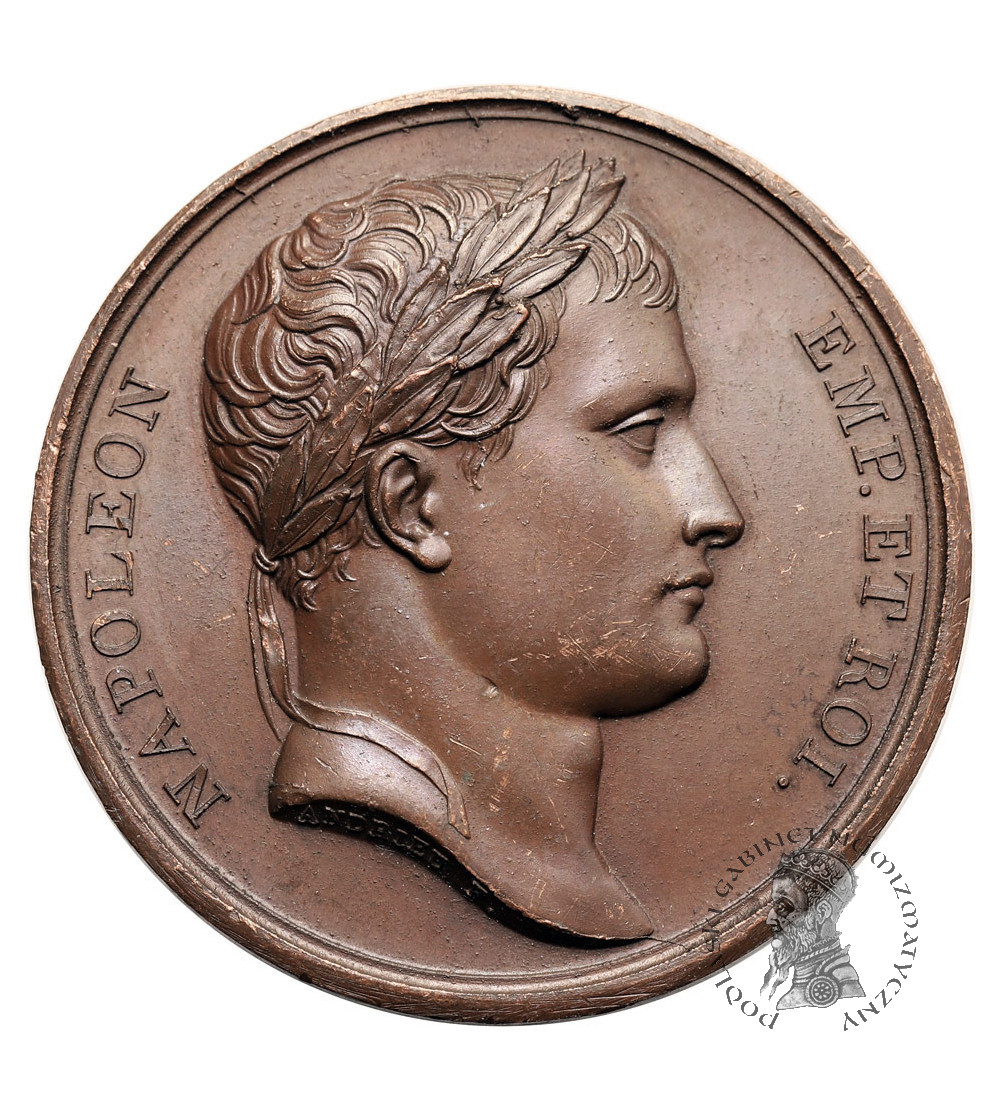



France / Silesia, Napoleon I Bonaparte. Medal commemorating the conquest of Silesia in 1807, Bertrand Andrieu, Bramsen 635, Julius 1748, Bronze 40,5 mm, weight 37,4 g., Condition XF, beautiful brown patina with subtle shades, small scratches, nice mint luster on reverse
France / Silesia, Napoleon I Bonaparte. Medal commemorating the conquest of Silesia in 1807, Bertrand Andrieu, Bramsen 635, Julius 1748, Bronze 40,5 mm, weight 37,4 g., Condition XF, beautiful brown patina with subtle shades, small scratches, nice mint luster on reverse
Although Silesia was a secondary theater of operations for Napoleon during the 1806–1807 campaign, he could not afford to underestimate its military significance. Therefore, following the declaration of war by Frederick William III, King of Prussia, and the defeat of his forces at Jena and Auerstedt in Thuringia, in the first days of November 1806, units of the Grande Armée under the command of Hieronymus Bonaparte, Napoleon’s youngest brother, entered Silesia. The French could not leave this area without military control, as Silesia, bordering Austria and possessing eight fortresses, could become a staging ground for a counterattack against the main forces of the Grande Armée marching eastward. Marching against them were the troops of Tsar Alexander I, who intended to support Prussia. Napoleon did not want to allow the Russian army to outflank his forces and enter Warsaw before him. In Silesia, it would have joined forces with its ally via Częstochowa, which remained in Prussian hands, and then the course of the 1806–1807 campaign could have taken a completely unexpected turn. A key factor determining the course of the fighting in 1806 and 1807 was the isolation of the Silesian theater of operations in New Silesia, which resulted mainly from the development of the Polish uprising there. At the end of the 18th century, this area still belonged to Lesser Poland, which was part of the Kraków Province, and was incorporated into the Prussian state only after the Third Partition of Poland in 1795.
However, when in 1806 the first Napoleonic eagles appeared in the lands of the Prussian part, and the appeal of Generals Jan Henryk Dąbrowski and Józef Wybicki called on their compatriots to take up arms, Nowa Śląsk was among the first Polish territories to join the fight. The nobility, as well as the inhabitants of towns and villages, had no doubt which side they should take in the great clash of powers.
The campaign of 1806–1807 brought Silesia not only occupation by the French army, but also the obligation to pay a massive indemnity imposed on defeated Prussia. The peace treaty with Napoleon also determined the territorial configuration of Silesia. After several days of negotiations in Tilsit, the treaty between France and Prussia, concluded on July 9, 1807, left Lower and Upper Silesia within the borders of the Kingdom of Prussia. Furthermore, bearing in mind the economic value of New Silesia, Prussian diplomats formulated the treaty’s articles in such a way that the area of western Lesser Poland, rich in natural resources, would also remain part of their country. Ultimately, however, the Polish uprising in New Silesia and the sacrifices of 1806 and 1807 prompted the French to support the claims of the Polish authorities, and in the final border settlement, the Elbląg Convention of November 10, 1807, the disputed territories were incorporated into the Duchy of Warsaw.
source: “Silesia during Napoleon’s campaigns in 1806/1807 and 1813,” Dariusz Nawrot, University of Silesia,
Nawrot D., Silesia during the Napoleon’s campaigns in 1806/1807 and 1813,
„Śląski Kwartalnik Historyczny Sobótka”, 2018, t.73, s. 97–120.